

A Bloom In Decay
What is religion to a dying man?
Pallor had found himself at the edge of the path, one foot dangling off the ledge in a stupor, and been faced with a predicament of sorts. It wasn’t as if Pallor had desired to fall off the cliff; on the contrary, he was deathly afraid of heights—it was a primordial fear, after all. Evolution had willed it so that humans were afraid of death, of darkness and isolation, and of heights. It was natural to be a little afraid of tall structures; Pallor was not ashamed of admitting this.
So, when he found himself falling, it was because he had found in himself neither a desire to stay on the ground nor to have fallen to his death. He desired, in that moment at the edge of the cliff, to exist in a state that existed between the two stages of standing still and falling to his death. A moment of flight independent of a before and an after. Amidst these moments of being drowned in his thoughts, however, he had accidentally let go of his other leg that stood precariously at the ledge and found himself falling.
Curiously, when Pallor was thinking about this existence between two states of equilibrium, he had inadvertently doomed himself to his fate, writing to himself a self-fulfilling prophecy. In his gripe with death and flying, he had subconsciously willed his leg to let go of the ledge, though he would not admit this to himself. He would swear on his life, the irony of such a swear evading him, that the ground had given way when he had been standing there, reasoning that the edges of cliffs are precarious to begin with.
The fall had broken Pallor’s back, but he wasn’t fortunate enough to be killed on impact. You see, it was shedding season for the trees. As a result, the ground had been besmirched by the falling leaves left in the trees' wake. The leaves, now piling over each other, cushioned Pallor’s fall just enough to not have killed him on impact, an ordeal that consequently led him to a fate of waiting for his body to bleed out to death.
Pallor did not subscribe to any isms, mostly due to his grade school teacher being a devout atheist, his mum a hippie-Hindu, and his dad a late-blooming Catholic convert. He simply did not know which of them were right, so instead, he chose to believe in all of them equally. This ordeal led to his faith being divided such that he ended up not believing in anything. However, despite his belief system being stretched between so many doctrines, his core belief on death was oddly theistic. It was such that he recognized death to occur in two stages: the death of the body and the death of the soul. Pallor prided himself an intellectual, and he reasoned that, for men such as himself, the death of the body always preceded the death of the soul. Now, with his spine shattered and blood pooling beneath him, he wondered, not without irony, which part of him was dying first?
In between this turbulence of his psyche trying to attach a concrete meaning to his death, Pallor couldn’t help but put out his hand to feel the leaves, which had been so merciless to him just a moment ago. He possessed within him gratitude towards their existence, for he envisioned what it would’ve been like to bleed to death on a harder, muddied ground devoid of the warmth of the withered leaves. He reasoned that dying in a place such as this and, on top of that, being denied the embrace of nature’s decay, would’ve been still more miserable than the death he had found himself. He was grateful to have his fall broken on leaves.
In this exploration of the decay, Pallor happened to chance upon a skull, its color fading and turning yellow, its ivory teeth now sparse and fragile. He dug the skull out of the leaves, then delicately placed it on his other hand, now stretched out towards the sky. The skull’s jaw lifted precariously on the tip of his fingers, its face tilted slightly towards him. One could make from the scene that the skull was looking down on Pallor.
Henceforth, it becomes uncertain how much of what Pallor sees is real and how much of it is fabricated in his head. One could theorize that the skull he accidentally happened to procure in his hand was a figment of his imagination trying to reason with the loss of his psyche. Or perhaps, for a simpler explanation, the skull did actually exist but belonged to a critter such as a squirrel or a monkey, and Pallor, in his delirium, imagined it to be that of a human. However, the truth hardly matters here, as, in Pallor’s state of mind, the skull existed as an absolute: it was the skull of his deceased wife.
“Masha,” he whispered to it, “you have always been a twisted one.”
“All these years you evade me, my memories of you a fading sunset, and now you choose to present yourself with this clarity—bright and unwavering, taking a form as grotesque as this one that you have chosen for yourself. And yet, in this ivory skull, you shine brighter than the sun, and you beckon to me in my death with this callousness, as if you can’t spare me a moment of respite in my own demise.”
“You play a mockery of me, Masha. You always did. A tease. A twisted one at that.”
Pallor pauses occasionally in between his sentences. It remains unclear whether the reason for his pauses is because he finds Masha to speak to him or because breathing to him had become an exercise, each one now more laborious than the last. However, his pauses between each sentence are sporadic and, at the same time, deliberate.
“I always brought flowers to your grave, Masha, just like you asked me to. Your grave has been riddled with flowers of all kinds. A wreath on a tombstone. A bloom in decay.”
He spots in his periphery two hikers in the distance, a man accompanied by a woman, both of them too involved in each other to spot Pallor lying amidst the leaves. Pallor refrains from calling out to them for help, mistaking them to be hallucinations in his delirium. His focus was indiscriminately at the skull in his hand.
“But who is to bring flowers to my grave now, Masha? We made this promise to each other, but as a twisted joke, you gave yourself up before me. Who is to make a wreath for me now?”
He tilts the skull further towards him, the base now tilted to such a degree that risks it falling off his fingertips.
“You were the diction of my being, Masha. The continual wiring to my psyche. I was engulfed so wholly by you that I am certain if I were to be opened up, they would find themselves unable to discern where I ended and you began. They would dig and dig, only to find us so intertwined within each other that, in trying to separate me from you, they would tear us apart so much that they’d end up with nothing on their hands.”
“It’s like trying to separate grains of sand, Masha. You can only separate so much before you risk losing the entire substance.”
He stares deep inside the skull’s eyes. For a moment, it seems more like a person than a rotten carcass.
“My body belonged more to you than me, Masha. As to my soul, I am still uncertain how much of it hasn’t been touched by your presence. Perhaps the entirety of my being finds its roots somewhere in you, and in that sense, separating us becomes impossible.”
He waited a moment, looking intently at the withering skull. Perhaps hoping for a reply, perhaps listening to one.
“Alas, dear Masha, this seems to be the end.”
His eyes betray tears from the realization that what was happening to him wasn’t fabricated by his head. Pallor was loosely aware of it at first, but now a sudden change had grounded itself inside of him. He was now aware of his mortality.
“I hope I am not found after all of this. This death is an idiotic one, and it can be said with certainty that they will claim this ordeal to be a suicide. But I do not desire to die, Masha. This is the one desire I refrain from, you know that.”
“I didn’t jump, Masha, believe me on that. I contemplated jumping. I fell during the contemplation. Is that truly a suicide? A philosophical accident? Or a cosmic joke?”
“I am not lying when I say I wish to not be found, beautiful Masha. I hope sincerely to remain hidden from the qualms of society. For I know that the trees will be kinder in decorating my grave than man. You were aware of it; hence, you whispered your desires to me. You knew I’d see them to the end, didn’t you, Masha?”
The wind was now beginning to pick up pace. All around him, the cacophony of leaves echoed in his ears.
“I hope to see you on the other side, if it indeed exists. This seems to be the only prayer I am left with, my love.”
He closes his eyes, now engaging his mind in a deep, meditative state.
“Farewell, Masha.”
He lets go of the skull, letting it slip from his hand. It strikes his chest once, then rolls off into the blood-soaked leaves, coming to rest at the edge of his arm, its gaze turned away from him. From one of its eye sockets, a single flower blooms—pale and trembling, a white flower in a pool of blood. Pallor does not notice. He is already too far into the act of dying.
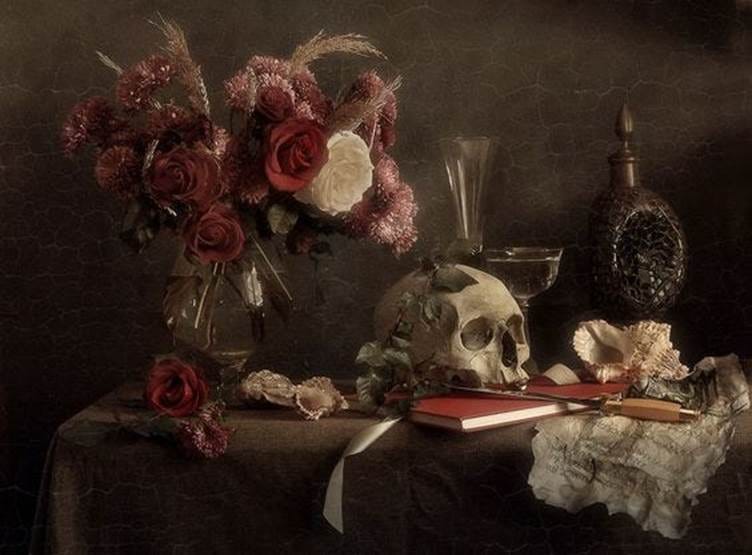
(Art from pinterest)
so if i fall from the terrace on to a bed of leaves - i'll be cushioned from death?! like so many other pieces of yours, this one to starts with ledge and goes on defying logic with beautiful prose every time. your romanticism does not even rest in the hot heat of may atharv - now that's determination. this was beautiful! love the nod to hamlet with the conversing skull and the love for tobias wolff's motifs. this felt like a work of literature! very well written!
i feel like everytime this guy posts, it's going to have this heart wrenching depiction of love, true, unconditional love as a backdrop of yearning, and i love it when I am not disappointed. not one bit. i loved the certain macabre aspect of this piece, albeit absurd, and how this macabreness actually plays with the absurdity. a skull in a heap of leaves? a rare sight. a guy falling and picking up the first thing he sees, a dried, old yellowish skull and the first thing he thinks of is his wife? god, the kind of romantic you are! it's like the wife becomes both a site of reproach and adoration: almost like, "i love you and i am dying here without you. i wish we could just die together because then, my death would be more meaningful and less tragic. i wish we died together, and fulfill eachother."
i love it. it's a kind of pathos. also, cannot help but appreciate two tiny details: one, of dried leaves = decay = death. and hikers = colder regions = lack of warmth. the setting itself becomes a huge dramatic irony: the casual nihilist suicidal guy is just the cherry on the top!
amazing writing as always, my guy! i am so proud of you!